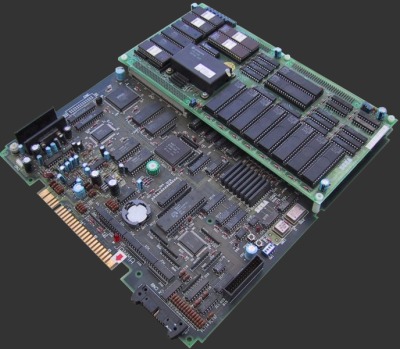
SEGA System 32
Sega System 32 (セガ システム 32) is the name of an arcade platform released by Sega that debuted in 1990. It was a successor to the Sega System 16, Sega System 24 and Sega Y Boards, and contains a 32-bit RISC processor at 16 MHz, hence its name.It was the last board to be released under the "Sega System" naming scheme, and was the last of the Sega System and Super Scaler series of arcade hardware – the "Sega Model" series would begin in 1992 with the Sega Model 1. Whereas Model 1 hardware was designed specifically with 3D polygon games in mind, System 32 primarily catered for sprite-based games, including 2D games and 3D sprite-scaling games. Like the Sega X Board and Sega Y Board, it is capable of scaling and rotating many sprites/textures in real-time, resulting in graphics ranging from a "pseudo-3D" look to a 3D texture-mapped look.
A variant of this hardware, System Multi 32, was created for use with twin cabinets, specifically for games where more than one player could play on separate screens. The Multi 32 variant was released in 1992. The System 32 series was supported along with the Model 1, due to the latter's lack of hardware texture mapping. They were succeeded by the Sega Model 2, which combined 3D polygons with texture mapping, making both the Model 1 and the System 32 series obsolete. The Sega Saturn console, released in 1994, combined hardware features of the System 32 series with that of the Sega Model series.
Unlike other Sega arcade hardware from this period, few System 32 games have ever been ported to home consoles. A re-imagining of Air Rescue hit European Sega Master Systems in 1992 (which although shares the same name, is almost completely different in design to the arcade version), OutRunners saw a vastly reduced port to the Sega Mega Drive by Data East and Rad Mobile was heavily tweaked and turned into Gale Racer for the Sega Saturn. Everything else seems to have been deemed "too good" for the Mega Drive and "not good enough" for the Saturn.