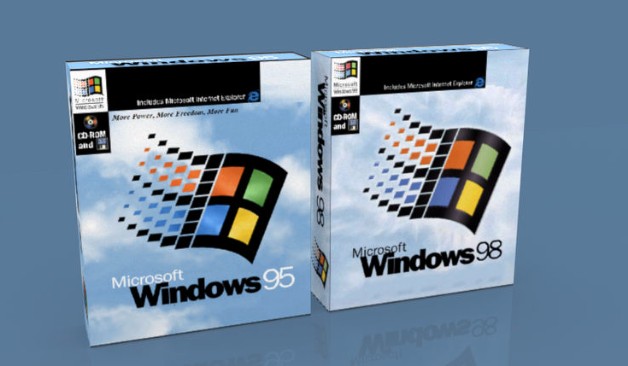
Windows 95/98
Windows 95 is a consumer-oriented operating system developed by Microsoft and the first of its Windows 9x line of operating systems, released to manufacturing on July 14, 1995, and generally to retail on August 24, 1995. Windows 95 merged Microsoft's formerly separate MS-DOS and Microsoft Windows products (an operating system and a family of graphical user shells) into a single product and featured significant improvements over its predecessor, most notably in the graphical user interface (GUI) and in its simplified "plug-and-play" features. There were also major changes made to the core components of the operating system, such as moving from a mainly cooperatively multitasked 16-bit architecture of its predecessor Windows 3.1 to a 32-bit preemptive multitasking architecture.
Windows 95 introduced numerous functions and features that were featured in later Windows versions, and continue in modern variations to this day, such as the taskbar, the notification area, file shortcuts on the desktop, plug and play driver integration, removal of the requirement to have a separate copy of MS-DOS, the ability to full screen application windows, native internet integration, raising the maximum letters a filename can have from eight to 255, the Windows Explorer, and the "Start" button which summons the Start menu. Accompanied by an extensive marketing campaign[1] that generated much prerelease hype, it was a major success and is considered to be one of the biggest and most important products in the personal computing industry. Three years after its introduction, Windows 95 was followed by Windows 98. Microsoft ended mainstream support for Windows 95 on December 31, 2000. Like Windows NT 3.51, which was released shortly before, Windows 95 received only one year of extended support, ending on December 31, 2001, the same day as classic versions such as Windows 3.x.
Windows 98 is a consumer-oriented operating system developed by Microsoft as part of its Windows 9x line of Microsoft Windows, a family of graphical user shells and operating systems. It was the second operating system in the 9x line, as the successor to Windows 95. It was released to manufacturing on May 15, 1998, and generally to retail on June 25, 1998. Like its predecessor, it is a hybrid 16-bit and 32-bit[3] monolithic product with the boot stage based on MS-DOS.[4]
Windows 98 is web-integrated and bears numerous similarities to its predecessor. Most of its improvements were cosmetic or designed to improve the user experience, but there were also a handful of features introduced to enhance system functionality and capabilities, including improved USB support and accessibility, and support for hardware advancements such as DVD players. Windows 98 was the first edition of Windows to adopt the Windows Driver Model, and introduced features that would become standard in future generations of Windows, such as Disk Cleanup, Windows Update, multi-monitor support, and Internet Connection Sharing.
Microsoft had marketed Windows 98 as a "tune-up" to Windows 95, rather than an entirely improved next generation of Windows. Upon release, Windows 98 was generally well-received for its web-integrated interface and ease of use, as well as its addressing of issues present in Windows 95, although some pointed out that it was not significantly more stable than Windows 95. In 2003 Windows 98 had approximately 58 million users. It saw one major update, known as Windows 98 Second Edition (SE), released on June 10, 1999. After the release of its successor, Windows Me in 2000, mainstream support for Windows 98 and 98 SE ended on June 30, 2002, followed by extended support on July 11, 2006 along with Windows Me's end of extended support.