
RGM Blogy

Just another Random Gaming Moments blog

Proudly powered by HTMLy, a databaseless blogging platform.
  • Posted on
    My FPGA Journey: Why Accuracy Still Matters

    I began my FPGA journey during the pandemic with one simple goal: to fill some gaps in my GameDex library. There were arcade games, classic computers, Nintendo handhelds, and other systems I wanted to explore and preserve in videos.

    At the time, I had no idea FPGA gaming would become as popular as it is today. What started as a way to experience more retro games eventually led me to purchase a second MiSTer FPGA unit to support dual-RAM cores, followed by the SuperStation One.

    Looking back, I can honestly say that FPGA has been one of the best gaming investments I've ever made.

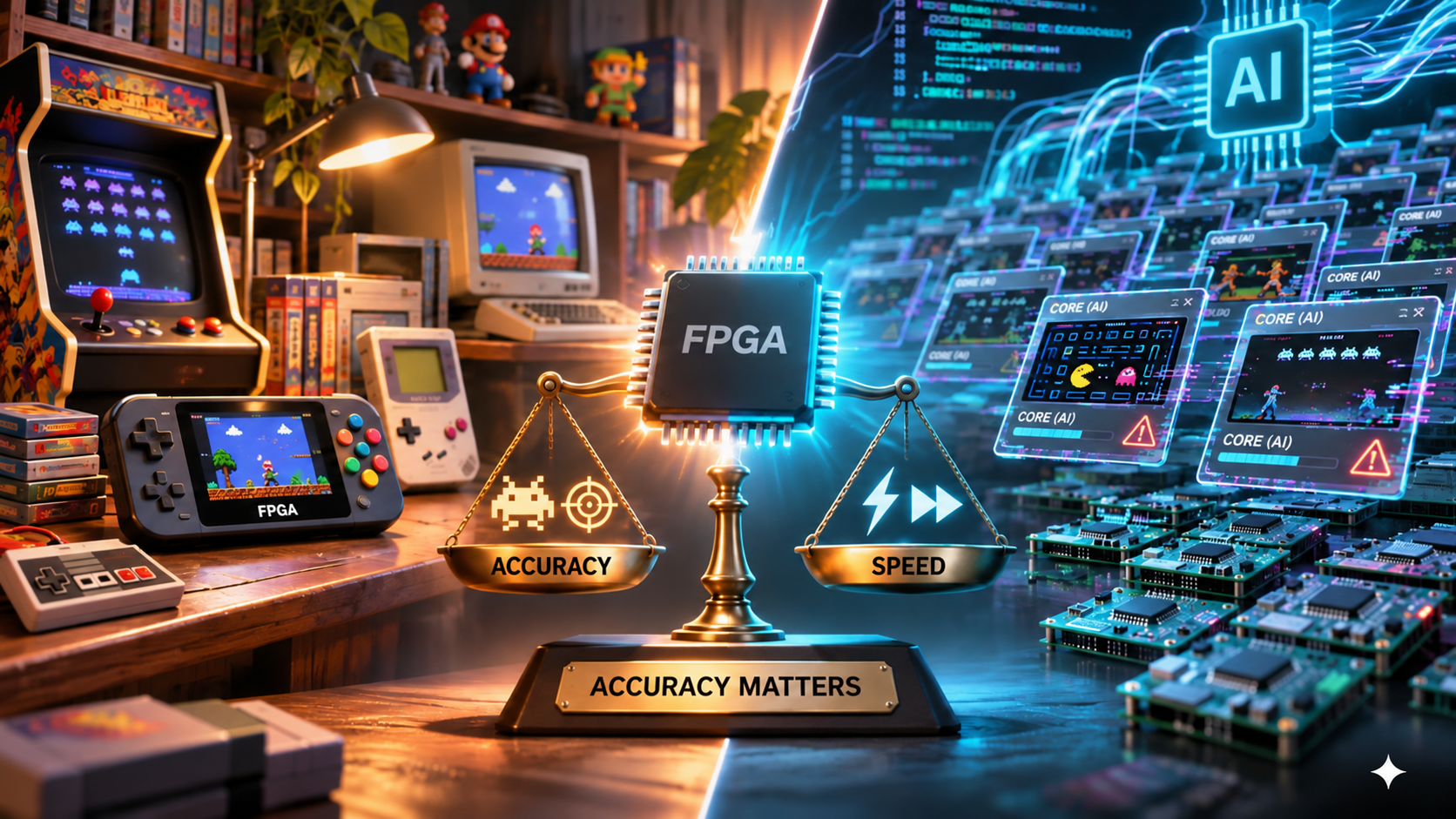
    However, the retro-gaming and MiSTer FPGA communities are now facing a growing divide over the rise of automated, AI-assisted cores. Some people have started referring to these releases as "AI slop" or MAME-derived "slop" cores, contrasting them with the traditional approach of carefully developed, hand-coded, cycle-accurate hardware implementations.

    Initially, I was excited about this new direction. After all, I don't make these cores, I just play them. If AI-assisted development could bring more arcade games and classic systems to FPGA hardware, I saw that as a positive development.

    But over the past few months, my enthusiasm has started to fade.

    We've reached a point where several new cores can appear in a single day. While that might sound impressive, quantity doesn't necessarily mean quality. Unfortunately, many of these releases have significant problems, including issues serious enough that, in my opinion, the cores should never have been released in their current state.

    I've personally tested many of these new cores, hoping to showcase them on my YouTube channel. However, I've encountered problems with nearly every one I've tried, often serious enough that I decided against making a video until those issues were resolved.

    As a result, I've significantly slowed down my coverage of newly released Ai FPGA cores.

    Another concern is what happens after the initial release. Some developers appear to move quickly from one core to the next, leaving earlier projects with very few updates, if any at all. We end up with an expanding collection of unfinished or poorly functioning cores rather than a growing library of accurate, dependable hardware implementations.

    In my opinion, that's not a healthy direction for the community.

    And let's not forget about MAME. It's a fantastic piece of software that has contributed enormously to arcade preservation. Many of the games being rushed into FPGA development can already be enjoyed through MAME, often with excellent results.

    For me, the appeal of FPGA gaming has never simply been about getting another game to run. It's about recreating the original hardware as faithfully as possible. That's what made MiSTer FPGA so special in the first place.

    I don't have a problem with AI being used as a development tool. If it helps talented developers create accurate, well-tested cores, that's great. But AI should assist the development process, not replace the careful testing, refinement, and commitment to accuracy that made FPGA gaming worth investing in.

    I'd rather see one carefully developed, accurate core released than ten unfinished ones rushed out the door.

    My position on this has changed considerably over the past few months. I was initially enthusiastic about the possibilities of AI-assisted FPGA development, but after spending time testing these releases, I've come to appreciate the traditional approach even more.

    FPGA gaming should remain focused on what made it special from the beginning: accuracy, quality, and faithful hardware preservation.

    More cores are always welcome, but not at the expense of the very principles that made this platform great.

  • Posted on

    enter image description here

    Konami is a titan that has shaped the gaming landscape for decades. Growing up, I knew the name and the iconic games, but I never fully grasped just how deeply ingrained they were into the bedrock of arcade culture. It wasn’t until the FPGA preservation boom really took off that the sheer scale of their engineering hit me: Konami wasn’t just a game developer, they were an absolute hardware juggernaut.

    Looking back at their custom board architectures reveals an incredible timeline of arcade innovation: (this is NOT all of them)

    Contra Hardware

    Twin 16

    Blades of Steel Hardware

    Double Dribble Hardware

    TMNT Hardware & TMNT 2 Hardware

    X-Men Hardware

    GX System

    System GV (Baby Phoenix)

    GQ System

    System 573 Analog & Digital

    Viper & Viper Satellite Terminal

    Python (PlayStation 2-based)

    Cobra

    When Hideo Kojima parted ways with the company, I felt burned out on modern Konami. For a while, I wrote them off entirely. But stripping away the contemporary corporate drama and evaluating their historical footprint puts things in perspective. From magnetic bubble-memory experiments and relentless four-player beat-’em-ups to pioneer rhythm-action cabinets and bleeding-edge multi-GPU arcade setups, Konami consistently drove the industry forward.

    Alongside titans like Nintendo, Sega, and Namco, Konami carried the medium through golden ages and transitional shifts alike. Whatever path they take today, their engineering legacy and arcade DNA demand our respect. Check out some of their games here. RGM GameDex

  • Posted on
    Happy Holidays from RGM! See you in 2026

    This year has been WILD! In 2025, the world of emulation and FPGA communities witnessed significant advancements in both software and hardware fronts.

    On the software front, emulators for various platforms saw notable updates aimed at enhancing performance, accuracy, and user-friendliness.

    On the FPGA front, Analogue showcased their highly anticipated N64 console, the Analogue 3D. The Super Station One releasing soon promises to be a fantastic device for those looking for an inexpensive entry into FPGA. The MiSTer FPGA project continued to be at the forefront of open-source hardware emulation, with discussions focusing on future capabilities like 4K-able scalers and higher refresh rates.

    The ongoing debate between software and hardware (FPGA) emulation raged on throughout the year, with each side having its strengths and weaknesses. While FPGAs offer cycle-accurate, low-latency hardware replication, software emulation remains dominant for more modern, complex systems like the PS2 and beyond, often leveraging game-specific hacks for better performance on modern PCs.

    2026 promises to be very exciting I cant wait!!

  • Posted on
    Happy Holidays from Random Gaming Moments

    🎉 Happy Holidays from Random Gaming Moments! 🎉

    To all our awesome viewers,

    As the year comes to a close, we want to wish you a joyful holiday season filled with laughter, love, and plenty of gaming fun! Thank you for being a part of our community and sharing in all the epic and hilarious moments we've had this year.

    We're taking a short break to recharge and spend time with loved ones, but don't worry—we'll be back with more amazing content after January 5th. Until then, enjoy the holidays and keep on gaming!

    Stay awesome, RGM 🎮✨

  • Posted on

    https://kinworx.com/gamedex/

    Over the past three decades, gamers have witnessed an evolution of gaming platforms that has transformed the way we experience entertainment. From humble beginnings to cutting-edge innovations, the world of console and PC gaming has undergone significant transformations.

    In the early 1990s, home consoles like Nintendo's Super NES and Sega's Genesis brought high-quality graphics and immersive gameplay to living rooms worldwide. The introduction of Sony's PlayStation in 1994 marked a new era of 3D gaming, setting the stage for future console generations.

    The late 1990s saw the rise of PC gaming, with the popularity of titles like Quake III Arena and Unreal Tournament. These games pushed the boundaries of graphics and gameplay, laying the groundwork for modern PC gaming.

    In the 2000s, the Xbox and PlayStation 2 consoles solidified their positions as major players in the gaming industry. The introduction of online multiplayer and HD graphics raised the bar for console gaming.

    The past decade has seen significant advancements in both console and PC gaming. Next-generation consoles like the PlayStation 5 and Xbox Series X have brought faster processors, improved graphics, and enhanced gameplay experiences. Meanwhile, PC gaming has continued to evolve with the rise of virtual reality (VR) and augmented reality (AR).

    Throughout this journey, gamers have had access to an incredible range of games across various genres, from action-adventure to role-playing, sports, and more. The world of gaming has become increasingly diverse, catering to a wide range of tastes and preferences.

    As we look to the future, it's exciting to think about what the next 30 years of console and PC gaming will bring. Will new technologies like cloud gaming and AI-powered game development change the face of the industry? Only time will tell, but one thing is certain – the world of gaming will continue to evolve and entertain us for generations to come. Over the past three decades, gamers have witnessed an evolution of gaming platforms that has transformed the way we experience entertainment. From humble beginnings to cutting-edge innovations, the world of console and PC gaming has undergone significant transformations.

    In the early 1990s, home consoles like Nintendo's Super NES and Sega's Genesis brought high-quality graphics and immersive gameplay to living rooms worldwide. The introduction of Sony's PlayStation in 1994 marked a new era of 3D gaming, setting the stage for future console generations.

    The late 1990s saw the rise of PC gaming, with the popularity of titles like Quake III Arena and Unreal Tournament. These games pushed the boundaries of graphics and gameplay, laying the groundwork for modern PC gaming.

    In the 2000s, the Xbox and PlayStation 2 consoles solidified their positions as major players in the gaming industry. The introduction of online multiplayer and HD graphics raised the bar for console gaming.

    The past decade has seen significant advancements in both console and PC gaming. Next-generation consoles like the PlayStation 5 and Xbox Series X have brought faster processors, improved graphics, and enhanced gameplay experiences. Meanwhile, PC gaming has continued to evolve with the rise of virtual reality (VR) and augmented reality (AR).

    Throughout this journey, gamers have had access to an incredible range of games across various genres, from action-adventure to role-playing, sports, and more. The world of gaming has become increasingly diverse, catering to a wide range of tastes and preferences.

    As we look to the future, it's exciting to think about what the next 30 years of console and PC gaming will bring. Will new technologies like cloud gaming and AI-powered game development change the face of the industry? Only time will tell, but one thing is certain – the world of gaming will continue to evolve and entertain us for generations to come.

    https://kinworx.com/gamedex/

  • Posted on
    Hello!

    I've been an avid gamer since I was ten years old. My first console was the Sega Master System, but to be honest, I was a bit disappointed because what I wanted was a NES. Nonetheless, the Master System ended up being a fantastic gaming system. Fortunately, I got my hands on a NES the following year. I am always on the lookout for new and lesser-known titles to play. My love for gaming took off at Nakamura Amusement Machine Manufacturing Company, known as NAMCO today. Those were some of the best times of my life. This channel showcases modern and classic games from all the amazing companies that have contributed to the industry, with a special focus on NAMCO. I would love to hear any game suggestions and am excited to connect with fellow gamers who share my interests. About me