
- Posted on
I began my FPGA journey during the pandemic with one simple goal: to fill some gaps in my GameDex library. There were arcade games, classic computers, Nintendo handhelds, and other systems I wanted to explore and preserve in videos.
At the time, I had no idea FPGA gaming would become as popular as it is today. What started as a way to experience more retro games eventually led me to purchase a second MiSTer FPGA unit to support dual-RAM cores, followed by the SuperStation One.
Looking back, I can honestly say that FPGA has been one of the best gaming investments I've ever made.
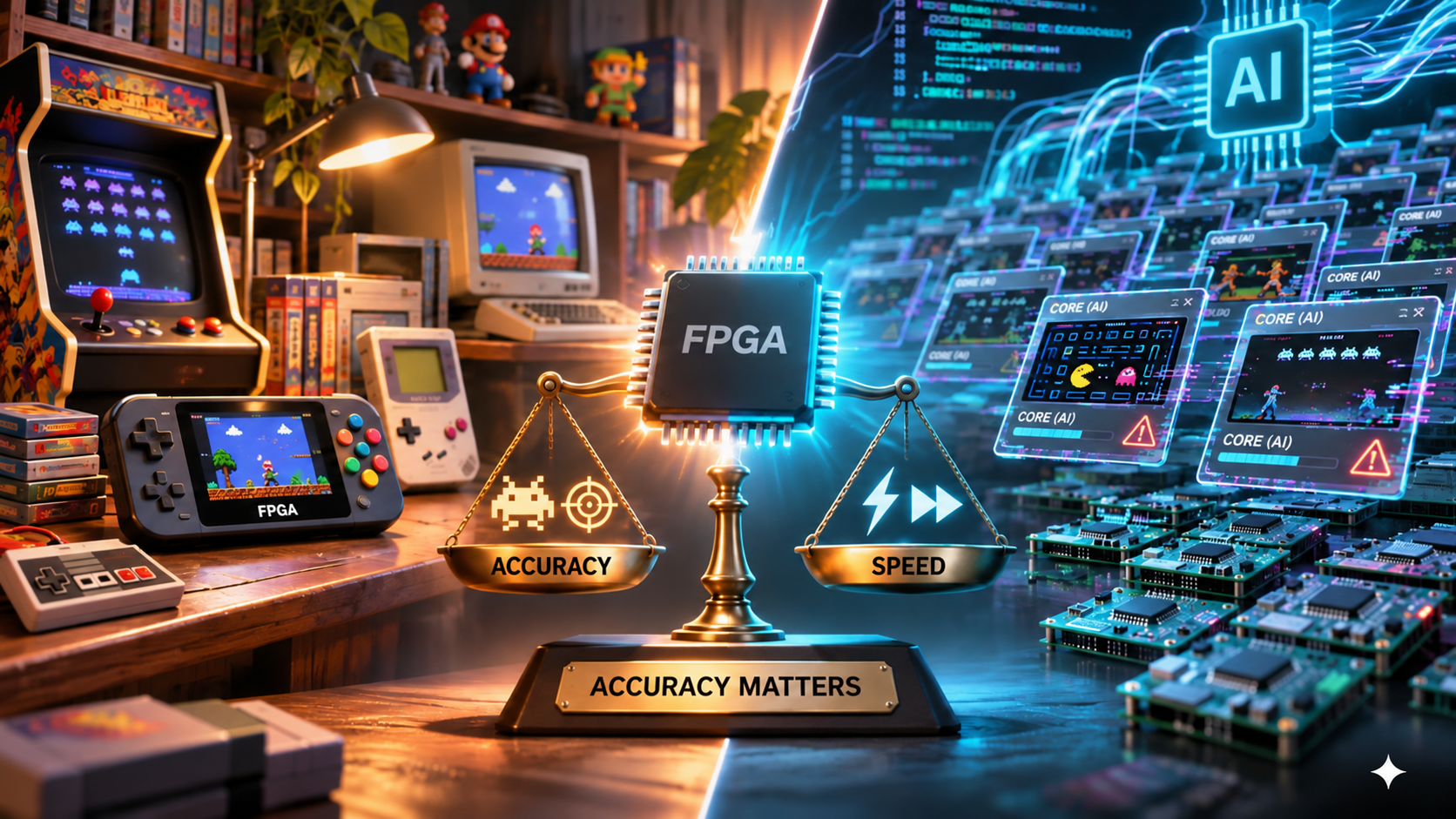
However, the retro-gaming and MiSTer FPGA communities are now facing a growing divide over the rise of automated, AI-assisted cores. Some people have started referring to these releases as "AI slop" or MAME-derived "slop" cores, contrasting them with the traditional approach of carefully developed, hand-coded, cycle-accurate hardware implementations.
Initially, I was excited about this new direction. After all, I don't make these cores, I just play them. If AI-assisted development could bring more arcade games and classic systems to FPGA hardware, I saw that as a positive development.
But over the past few months, my enthusiasm has started to fade.
We've reached a point where several new cores can appear in a single day. While that might sound impressive, quantity doesn't necessarily mean quality. Unfortunately, many of these releases have significant problems, including issues serious enough that, in my opinion, the cores should never have been released in their current state.
I've personally tested many of these new cores, hoping to showcase them on my YouTube channel. However, I've encountered problems with nearly every one I've tried, often serious enough that I decided against making a video until those issues were resolved.
As a result, I've significantly slowed down my coverage of newly released Ai FPGA cores.
Another concern is what happens after the initial release. Some developers appear to move quickly from one core to the next, leaving earlier projects with very few updates, if any at all. We end up with an expanding collection of unfinished or poorly functioning cores rather than a growing library of accurate, dependable hardware implementations.
In my opinion, that's not a healthy direction for the community.
And let's not forget about MAME. It's a fantastic piece of software that has contributed enormously to arcade preservation. Many of the games being rushed into FPGA development can already be enjoyed through MAME, often with excellent results.
For me, the appeal of FPGA gaming has never simply been about getting another game to run. It's about recreating the original hardware as faithfully as possible. That's what made MiSTer FPGA so special in the first place.
I don't have a problem with AI being used as a development tool. If it helps talented developers create accurate, well-tested cores, that's great. But AI should assist the development process, not replace the careful testing, refinement, and commitment to accuracy that made FPGA gaming worth investing in.
I'd rather see one carefully developed, accurate core released than ten unfinished ones rushed out the door.
My position on this has changed considerably over the past few months. I was initially enthusiastic about the possibilities of AI-assisted FPGA development, but after spending time testing these releases, I've come to appreciate the traditional approach even more.
FPGA gaming should remain focused on what made it special from the beginning: accuracy, quality, and faithful hardware preservation.
More cores are always welcome, but not at the expense of the very principles that made this platform great.